
Building website authority has traditionally been associated with acquiring backlinks. For years, businesses and SEO professionals have focused on increasing the number of websites linking to their pages, assuming that more backlinks automatically lead to higher search rankings.
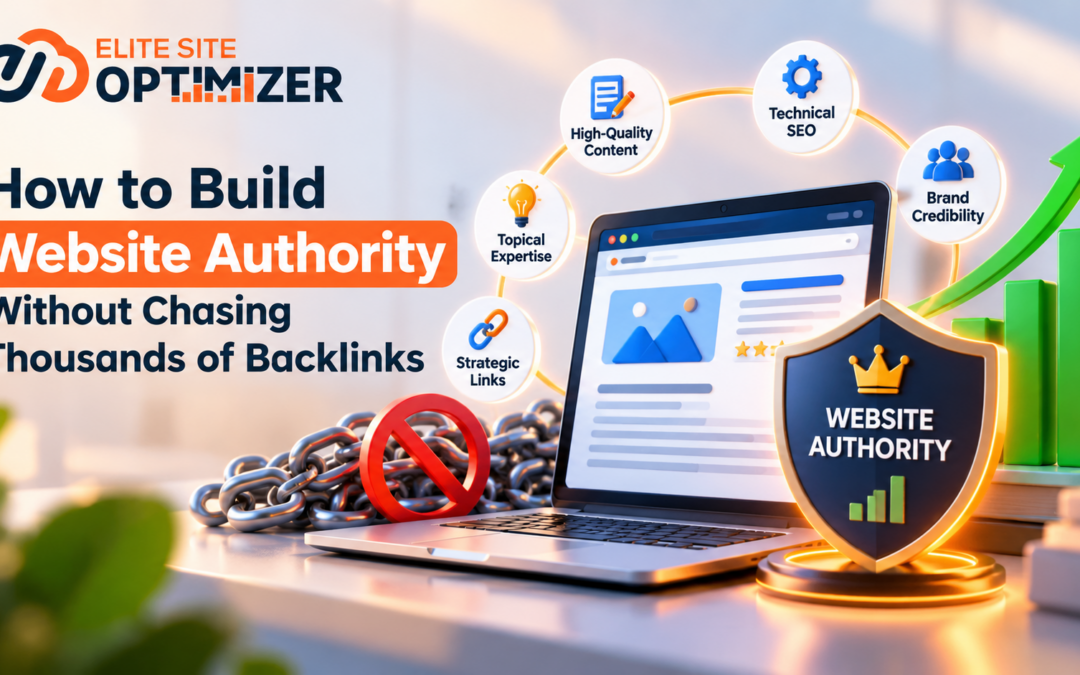
However, modern search engine optimization is more complex. While backlinks remain an important SEO signal, website authority is not determined by backlink quantity alone. Understanding how to build website authority involves focusing on content quality, topical expertise, technical performance, user experience, and brand credibility to improve a website’s ability to compete in search results.
The good news? You don’t need thousands of backlinks to build a credible and competitive website.
By focusing on the right SEO strategies, businesses can strengthen their online presence, attract qualified organic traffic, and establish long-term digital authority.
1. Understand What Website Authority Really Means
Website authority refers to the credibility, relevance, and trustworthiness a website establishes within its industry or subject area.
It is important to distinguish website authority from third-party metrics such as Domain Authority (DA) and Domain Rating (DR). These metrics estimate aspects of a website’s link profile, but they are not official Google ranking factors.
A strong website typically demonstrates:
- High-quality, relevant, and trustworthy content.
- Clear expertise within a specific industry.
- A well-organized website structure.
- Positive user experiences and strong technical performance.
- Relevant backlinks and reputable brand mentions.
- Consistent information across digital platforms.
Instead of focusing exclusively on backlink numbers, businesses should develop a comprehensive website authority-building strategy that strengthens these elements together.
2. Build Topical Authority With Content Clusters
One of the most effective ways to establish website authority is by developing comprehensive content around a specific subject.
Rather than publishing unrelated articles targeting individual keywords, organize your content into topic clusters.
A topic cluster includes a central pillar page supported by multiple related articles.
For example, a website specializing in SEO could build a content cluster around Technical SEO:
- Technical SEO: A Complete Guide
- How to Fix Website Crawling Issues
- Core Web Vitals Optimization Strategies
- How to Improve Website Indexing
- Common Technical SEO Mistakes
- Website Audit Checklist for Businesses
Each supporting article links naturally to the pillar page and other relevant resources.
This structure helps search engines discover relationships between pages while demonstrating comprehensive subject coverage.
SEO Tip: Focus on answering related user questions thoroughly rather than producing hundreds of thin articles. Content depth and relevance are more valuable than publishing volume alone.
3. Publish Original, Experience-Driven Content
Search engines increasingly emphasize helpful, reliable content created for users.
According to Google Search Central, valuable content should demonstrate real expertise and provide information that genuinely helps readers.
To strengthen website credibility, publish content that goes beyond information already available online.
Consider creating:
- Original research and industry surveys.
- Case studies highlighting real business outcomes.
- Expert interviews and practical insights.
- Step-by-step tutorials based on actual experience.
- Data-driven comparisons and industry reports.
For example, instead of writing another generic article about website performance, publish a case study explaining how specific technical improvements affected page speed and user engagement.
Original insights provide genuine value and give other websites meaningful reasons to reference your content.
Over time, this approach can attract backlinks naturally without aggressive outreach.
4. Strengthen Internal Linking to Distribute Authority
Internal linking is one of the most overlooked strategies for improving website authority.
Unlike external backlinks, internal links are completely within your control.
A strong internal linking structure helps search engines discover important pages, understand content relationships, and navigate your website efficiently.
To improve your internal linking strategy:
- Identify high-value pages that deserve greater visibility.
- Connect relevant blog articles to important service or product pages.
- Use descriptive, natural anchor text.
- Fix broken internal links and unnecessary redirects.
- Ensure important pages are accessible through logical navigation.
For example, an article about website accessibility can link to related guides covering WCAG compliance, accessibility audits, and inclusive website design.
These connections strengthen topical relationships while helping visitors find useful information.
Key takeaway: A well-connected website can make better use of its existing backlinks without constantly acquiring new ones.
5. Improve Technical SEO and Website Performance
Even excellent content may struggle to perform when technical issues prevent search engines from accessing or understanding it.
Technical SEO provides the foundation for sustainable organic visibility and plays an important role in strengthening Website Authority.
Important areas to optimize include:
- Website speed and Core Web Vitals: Improve loading performance, visual stability, and responsiveness to create smoother browsing experiences.
- Mobile usability: Ensure pages function correctly across smartphones, tablets, and desktop devices.
- Crawlability and indexing: Review robots.txt directives, XML sitemaps, canonical tags, and indexing problems.
- Structured data: Implement appropriate schema markup to help search engines interpret relevant page information.
- Website accessibility: Improve navigation, readability, and accessibility for users with different abilities.
Regular technical SEO audits help identify problems before they affect large portions of a website.
Maintaining technical website health requires regular attention to crawlability, indexing, redirects, and page structure. Even valuable content may struggle to perform when search engines cannot access or interpret important pages correctly. Identifying these issues early helps businesses maintain a stronger foundation for organic visibility. Explore how to simplify technical SEO through structured website audits and ongoing monitoring.
Google’s guidance also emphasizes providing a strong overall page experience rather than optimizing only one performance metric.
6. Build Brand Credibility Beyond Backlinks
A recognizable brand can strengthen a website’s broader online reputation. Businesses looking to improve website credibility should focus on building brand awareness, establishing trust, and demonstrating genuine expertise rather than concentrating solely on link-building campaigns.
Effective strategies include:
- Participating in relevant industry webinars and podcasts.
- Publishing thought leadership articles.
- Sharing useful insights on LinkedIn and other professional platforms.
- Contributing expert opinions to reputable industry publications.
- Maintaining accurate business profiles.
- Earning authentic customer reviews and testimonials.
Brand mentions without hyperlinks may increase awareness and referral discovery, although they should not automatically be treated as equivalent to backlinks for ranking purposes.
The objective is to establish a reputation that users recognize and trust.
As more people discover and engage with your brand, opportunities for editorial coverage, partnerships, referrals, and natural backlinks can increase.
7. Optimize Existing Content Instead of Constantly Publishing More
Many websites already have valuable content that is underperforming because it has become outdated, incomplete, or poorly optimized.
Refreshing these pages can be more efficient than producing new articles every week. Regular content updates can help improve Organic Search Visibility by keeping information relevant, accurate, and aligned with user search intent.
Start by identifying pages that have:
- Declining organic traffic.
- High impressions but low click-through rates.
- Outdated information or broken references.
- Weak internal linking.
- Incomplete answers to search queries.
- Rankings near the first page of search results.
Update these pages with current information, stronger examples, improved headings, and relevant internal links.
Also review overlapping articles that compete for similar search intent. Where appropriate, consolidate them into a more comprehensive resource.
Content optimization should be a continuous process rather than a one-time activity.
Regularly reviewing existing pages helps businesses identify content gaps, readability issues, and outdated information that may affect search performance. A structured content review also helps ensure that pages continue to match user expectations and search intent. Improving existing resources can be more valuable than constantly publishing new articles without reviewing their effectiveness. Discover how AI-powered content analysis can support a more consistent content optimization process.
8. Earn Fewer, More Relevant Backlinks
Building website authority without chasing thousands of backlinks does not mean ignoring link building entirely.
It means prioritizing link quality, relevance, and editorial value. Effective SEO authority building focuses on earning trustworthy backlinks that support long-term search visibility and strengthen a website’s reputation.
A contextual backlink from a respected publication within your industry may be more useful than numerous links from unrelated, low-quality websites.
Building authority also requires understanding the quality of websites linking to your content. Reviewing referring domains, link relevance, and new or lost backlinks helps businesses evaluate their backlink profiles more effectively. Instead of focusing only on link quantity, marketers should prioritize meaningful connections that support long-term visibility. Learn more about backlink analysis for SEO growth and how to evaluate backlink quality.
Focus on earning links through:
- Original research worth citing.
- Useful free tools and downloadable resources.
- Relevant digital PR campaigns.
- Expert contributions and genuine industry collaborations.
- Comprehensive guides that answer difficult questions.
Avoid purchasing links intended to manipulate rankings or participating in automated link schemes.
Sustainable link acquisition should support your broader SEO strategy, not dominate it.
9. Measure Authority Through Meaningful SEO Performance Metrics
Backlink counts and third-party authority scores provide useful context, but they should not be the only measurements of SEO success.
Monitor indicators that reflect real visibility and business outcomes.
| SEO metric | What it helps measure |
| Organic traffic | Search visibility and visitor acquisition |
| Keyword rankings | Progress across relevant search queries |
| Organic conversions | Business value generated from search |
| Referring domains | Diversity and relevance of external linking sites |
| Indexed pages | Search engine discovery and indexing coverage |
| Branded search demand | Changes in brand awareness |
| Engagement metrics | How visitors interact with website content |
Reviewing these metrics together provides a clearer picture of how your website’s visibility, credibility, and effectiveness are evolving.
Conclusion: Build Authority Through Value, Not Volume
Website authority is not a competition to collect the largest number of backlinks.
It develops through consistent content quality, subject expertise, technical reliability, strong internal linking, and meaningful brand visibility. Businesses that consistently publish relevant, informative content can build topical authority and establish themselves as trusted sources within their industries.
Businesses that focus on helping users, addressing technical weaknesses, and establishing credibility can achieve sustainable search performance without depending on large-scale backlink campaigns.
The goal is not simply to earn more links. It is to build a website that deserves to be discovered, trusted, and referenced.
Strengthen Your Website Authority With Elite Site Optimizer
Building website authority requires more than publishing content and monitoring backlinks. You need to understand how your entire website performs and where optimization opportunities exist.
Elite Site Optimizer (ESO) is an AI-powered website optimization platform designed to help businesses, SEO professionals, and digital marketing agencies improve website visibility and performance.
With Elite Site Optimizer, you can:
- Analyze technical SEO: Identify crawling, indexing, metadata, and on-page optimization issues.
- Monitor keyword rankings: Track search visibility and identify opportunities to improve rankings.
- Evaluate backlinks: Review referring domains and backlink quality.
- Analyze competitors: Discover competitive SEO gaps and optimization opportunities.
- Improve website performance: Identify speed and usability issues affecting visitor experience.
- Assess AI readiness: Evaluate how effectively your website supports discovery and visibility across AI-driven search experiences.
Instead of chasing thousands of backlinks, make informed decisions that strengthen your website’s overall SEO foundation.
Want to strengthen your website authority with a smarter SEO strategy? Contact our SEO experts to explore how Elite Site Optimizer can help improve your website’s search visibility and performance.
Build credibility. Improve visibility. Grow authority with Elite Site Optimizer.
Start Your Free Website Audit with Elite Site Optimizer →
Ready to improve your website’s search performance?
Sign up for Elite Site Optimizer and start analyzing your website’s SEO, accessibility, performance and content quality.
Start Your Free Signup