

Introduction
For years, keyword rankings were one of the most important indicators of SEO success. Businesses tracked their Google positions, targeted high volume keywords, and optimized websites to reach the first page of search results.
But search behavior is changing.
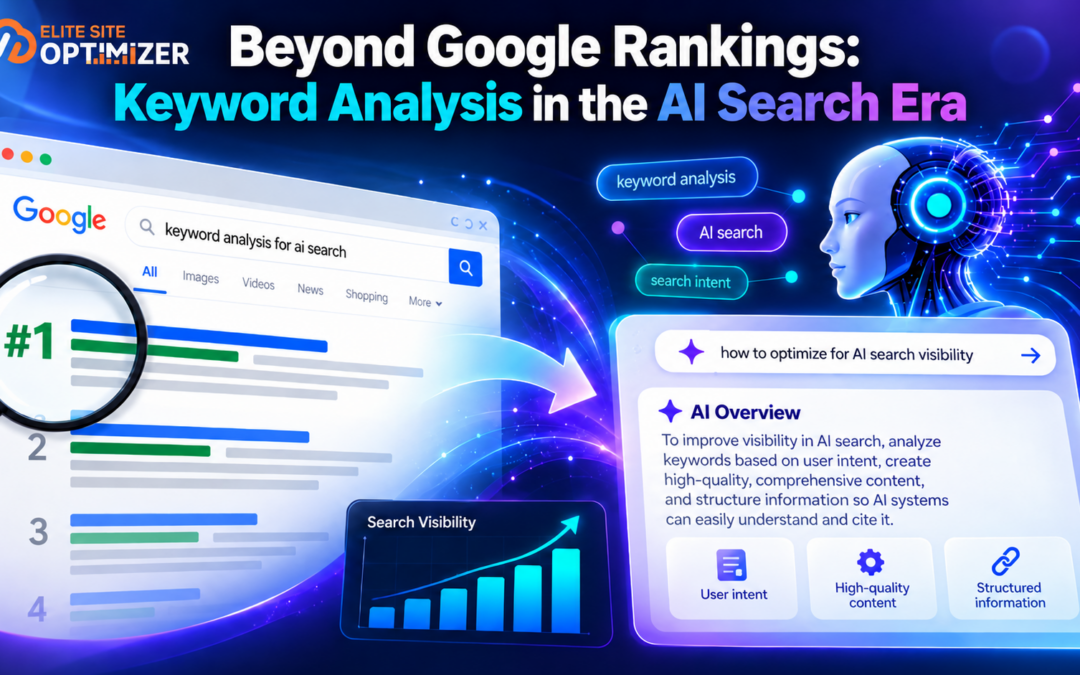
With the rise of Google AI Overviews, Chat GPT, Perplexity, and other AI-powered search experiences, users can discover information, compare solutions, and receive recommendations without following the traditional search journey.
Today, ranking on Google’s first page is valuable, but it no longer tells the complete story.
A website might rank well for important keywords yet experience declining organic traffic. Meanwhile, competitors may gain AI search visibility through AI-generated responses that recommend or reference their content.
This shift raises an important question: Are your keywords helping customers discover your business across both traditional and AI-powered search?
Understanding this requires a modern approach to SEO keyword analysis that goes beyond rankings and search volume.
Why Traditional Keyword Rankings Are No Longer Enough
Traditional keyword analysis primarily focuses on metrics such as:
- Keyword search volume
- Ranking position
- Keyword difficulty
- Organic traffic
- Click-through rate (CTR)
These metrics remain essential, but AI-powered search introduces additional factors that influence online visibility.
For example, a user searching for “best SEO tools for small businesses” may receive an AI-generated comparison highlighting several platforms.
Instead of opening multiple search results, the user might evaluate the recommendations directly within the AI response.
This creates a new challenge for businesses: Ranking for a keyword doesn’t necessarily guarantee traffic, engagement, or conversions.
Google also confirms that traditional SEO fundamentals remain relevant to its generative AI search features. Therefore, businesses should expand their keyword strategies rather than replace established SEO practices.
How AI Search Is Changing Keyword Analysis
1. Search Intent Matters More Than Exact Keywords
Traditional SEO often focuses on matching specific keywords with website content.
AI-powered search can interpret longer, conversational questions and understand the context behind a user’s request.
For example:
Traditional keyword: “SEO audit tool”
Conversational AI search: “Which SEO audit tool can help me identify technical issues and improve my website’s AI search visibility?”
Both searches relate to SEO tools, but the second reveals more detailed requirements and buying intent.
Businesses should analyze the questions customers ask, their underlying problems, and the solutions they expect.
Optimization tip: Build content around user questions, practical solutions, and related keyword variations rather than repeating a single keyword.
2. AI Search Visibility Is Becoming an Important Metric
A website’s visibility is no longer limited to its position in traditional search results.
Businesses should also investigate whether their content appears as a cited source or recommendation in AI-generated answers as part of their AI search optimization strategy.
Key Insight: Measuring AI Search Visibility
Traditional keyword rankings alone cannot measure your complete search presence.
Focus on three important signals:
AI Citations: How often AI-generated answers reference your website.
Brand Mentions: How frequently your brand appears in relevant AI search results.
Competitor Visibility: Where competitors are recommended or cited instead of your business.
Remember: AI search visibility is dynamic. Monitor these signals regularly to discover content gaps, strengthen topical authority, and improve your overall search strategy.
3. Long-Tail and Conversational Keywords Offer New Opportunities
Long-tail keywords have always been valuable for attracting targeted traffic.
In the AI search environment, conversational queries become especially important because people can ask detailed questions and follow up naturally.
Consider these examples:
| Traditional Keyword | Conversational Search Query |
| Website accessibility checker | How can I check whether my website meets WCAG accessibility standards? |
| Keyword ranking tool | Why are my keywords ranking but not generating website traffic? |
| Technical SEO audit | What technical SEO issues could prevent my website from appearing in search results? |
| Competitor SEO analysis | How can I identify keywords that bring traffic to my competitors? |
These questions provide opportunities to create helpful articles, FAQs, comparison guides, and solution-focused landing pages.
Rather than creating separate pages for every keyword variation, businesses should group closely related questions into comprehensive content that satisfies the user’s overall intent.
5 Essential Steps to Analyze Keywords for AI Search
Step 1: Evaluate Keyword Performance Beyond Rankings
Start by reviewing your existing keyword performance.
Identify keywords that generate impressions but receive fewer clicks than expected.
Look for patterns such as:
- High impressions with declining CTR
- Stable rankings but reduced organic sessions
- Keywords bringing traffic without conversions
- Pages losing visibility for important search queries
A keyword ranking in the top five positions may still underperform commercially.
Compare ranking trends with search impressions, traffic, engagement, and conversions to understand whether the keyword contributes to business growth.
Step 2: Identify Search Intent and Topic Clusters
Group keywords based on their underlying purpose.
Common categories include:
Informational: Users looking for explanations or solutions.
Commercial: Users comparing products, platforms, or service providers.
Transactional: Users ready to purchase, subscribe, or request a demo.
Navigational: Users searching for a particular brand or website.
Next, organize related keywords into topic clusters.
For example, a primary topic such as “website SEO optimization” could include technical SEO audits, keyword analysis, website performance, search visibility, and competitor research.
This approach supports comprehensive content and helps visitors find related information.
Step 3: Analyze Competitor Visibility Across Search Experiences
Competitor analysis should extend beyond identifying who ranks above your website.
Evaluate competitors across traditional and AI-powered search experiences.
Ask questions such as:
- Which competitors rank for your target keywords?
- Which websites are cited in AI-generated answers?
- What questions are competitors answering effectively?
- Which topics lack detailed or trustworthy explanations?
- Where can your business provide better information?
For example, competitors may rank strongly for “AI SEO optimization” but offer limited guidance about measuring AI citations.
Publishing original, practical content about that gap could help your business differentiate itself.
Step 4: Optimize Content for AI Understanding and User Value
AI search optimization isn’t about adding more keywords.
The priority is creating content that people can understand, trust, and use.
Effective practices include:
- Write clear headings that reflect user questions.
- Provide concise answers supported by deeper explanations.
- Include original insights, examples, and reliable evidence.
- Keep important information accurate and updated.
- Use descriptive internal links between relevant pages.
- Ensure important content is crawlable and accessible.
- Implement appropriate structured data that matches visible content.
Google emphasizes that helpful, original content and technical SEO fundamentals fundamentals remain important for generative search visibility. No special AI-specific schema markup is required to appear in Google’s AI features.
Step 5: Measure Keyword Success Using Expanded SEO Metrics
Modern keyword analysis requires a broader performance framework.
Instead of focusing only on ranking position, evaluate how effectively keywords contribute to discovery, engagement, and conversions.
| SEO Metric | What It Helps Measure |
| Keyword Rankings | Traditional search visibility |
| Organic CTR | Ability to attract clicks from search results |
| Search Intent Alignment | How well content satisfies user needs |
| AI Citations | Content references in supported AI experiences |
| Competitor Visibility | Opportunities and competitive gaps |
| Organic Conversions | Business results from organic visitors |
Measurement capabilities are also evolving.
Google introduced dedicated generative AI performance reporting in Search Console in 2026, while Bing Webmaster Tools provides AI citation insights for supported Microsoft AI experiences.
Combining these insights with analytics data helps businesses better evaluate their search performance.
Common Keyword Analysis Mistakes to Avoid
Even experienced SEO teams can overlook important signals when adapting to AI-powered search.
Focusing only on high-volume keywords: Search volume doesn’t always indicate commercial value or user intent. Search intent analysis helps identify what users are actually looking for.
Ignoring conversational queries: Valuable opportunities can be missed when keyword research excludes natural-language questions.
Tracking rankings without traffic analysis: Strong rankings mean little if users aren’t visiting or converting.
Overlooking competitor content gaps: Competitor rankings and AI citations can reveal unmet information needs.
Publishing content only for AI systems: Content should primarily help people, with clear information, credible evidence, and useful explanations.
Avoiding these mistakes creates a more balanced strategy for traditional SEO and AI search visibility.
The Future of Keyword Analysis: From Rankings to Discoverability
Keyword analysis is no longer just about tracking rankings. It’s about understanding how customers discover, evaluate, and choose solutions across traditional and AI-powered search.
Modern keyword analysis connects:
Search intent and keyword performance
Content quality and technical website health
Competitor insights and AI search visibility
The goal isn’t simply to rank for more keywords. It’s to become a relevant, trustworthy source across multiple search experiences.
This approach helps businesses identify content opportunities, make informed SEO decisions, and achieve sustainable organic growth.
Go Beyond Keyword Rankings with Elite Site Optimizer
Turn Keyword Insights into Search Growth
Ranking keywords is only the beginning. Understanding why your website gains or loses visibility is what helps you improve performance.
Elite Site Optimizer (ESO) helps businesses, SEO professionals, and digital marketing agencies analyze website performance and discover optimization opportunities.
With Elite Site Optimizer, you can:
- Track Keyword Rankings: Monitor keyword positions and identify ranking changes.
- Analyze Keyword Opportunities: Discover relevant keywords to strengthen your content strategy.
- Identify Missed Click Opportunities: Find search queries with untapped traffic potential.
- Perform Competitor Analysis: Compare performance and uncover opportunities to improve visibility.
- Assess AI Readiness: Evaluate website areas that may need improvement for AI-driven search.
- Improve Technical SEO: Detect website issues that could affect crawling, performance, and search visibility.
As search evolves, businesses need more than keyword positions. They need actionable insights to make smarter optimization decisions.
Move beyond rankings. Discover opportunities. Build a stronger search presence with Elite Site Optimizer.
Ready to improve your website’s search performance?
Sign up for Elite Site Optimizer and start analyzing your website’s SEO, accessibility, performance and content quality.
Start Your Free Signup