A digital accessibility solution is essential today, particularly in the context of the growing digital transformation of businesses around the globe. Usability of any digital platform needs to be equal, which requires inclusive design thinking and special integrations that also considers individuals with disabilities.
Accessibility is the ability to define who is in, or is considered, included in a digital experience. Technology is at the forefront of supporting creating and implementing digital accessibility solutions. AI, automation, and machine learning are leading the charge in how organizations can approach digital accessibility solutions and compliance to standards such as the W3C and WCAG.
Why Digital Accessibility Solution Matters in 2026 and Beyond

Digital accessibility means that people with any sort of visual, auditory, motor, or cognitive ability can access a website, app, or digital content. It has become significantly meaningful since many countries have developed legal frameworks that are in line with WCAG.
However, WCAG compliance tools are only one aspect of the problem. Accessibility improves user experience for everyone and brings value to brand reputation and customer engagement. Many organizations recognize that accessible content is valuable and will benefit the organization in the long run.
Until recently, accessibility audit automation was cumbersome and involved lengthy processes requiring extensive manual testing, a human evaluator testing the website from top to bottom, and periodic audit management. AI accessibility tools and automation are disrupting this space for great reform.
94.8% of homepages still contain detectable WCAG 2 failures in 2026, with only a 3.1% improvement in six years, indicating that full WCAG 2 A/AA compliance remains far lower.
AI in Accessibility: Changing How Organizations Achieve WCAG Compliance
AI has changed the accessibility status quo for anyone to achieve accessibility with their website, and today we have AI automation tools that have improved the accessibility practice, and it has also allowed for improvements in speed, scale, and accuracy of the process in accessibility testing and content creation.
- Automation of Accessibility Testing
AI testing tools can scan thousands of web pages in minutes to identify accessibility issues, such as missing alt text, a lack of a proper heading structure, and/or all text lacking sufficient contrast with the background.
The automated tools generally utilize machine learning algorithms or some types of AI frameworks to support the ability to identify patterns of potential accessibility barriers. Additionally, the tools continually advance, becoming smarter as they learn user behaviors, and audit updates are completed.
- Customization for Users with Disabilities
Apart from AI for web accessibility, machine learning models can assist in identifying user needs and preferences in order to create a personalized digital experience. For example, a user with auditory challenges could be provided subtitles in audio-based content, or a user with a color vision deficiency could see a higher level of contrast.
AI systems can learn from real user behavior and then improve accessibility for users, as the digital experience can adapt and evolve through behavior.
- Intelligent Remediation
In addition to detection, AI for web accessibility can help with remediation by suggesting intelligent solutions. For example, AI can generate image description output or offer improvements for screen reader alternative text. Natural language processing capabilities can enable a tool to produce content that is meaningful and relevant to the context, improving the experience for users who have visual impairments.
Automation of Accessibility Testing for Faster, More Reliable Results
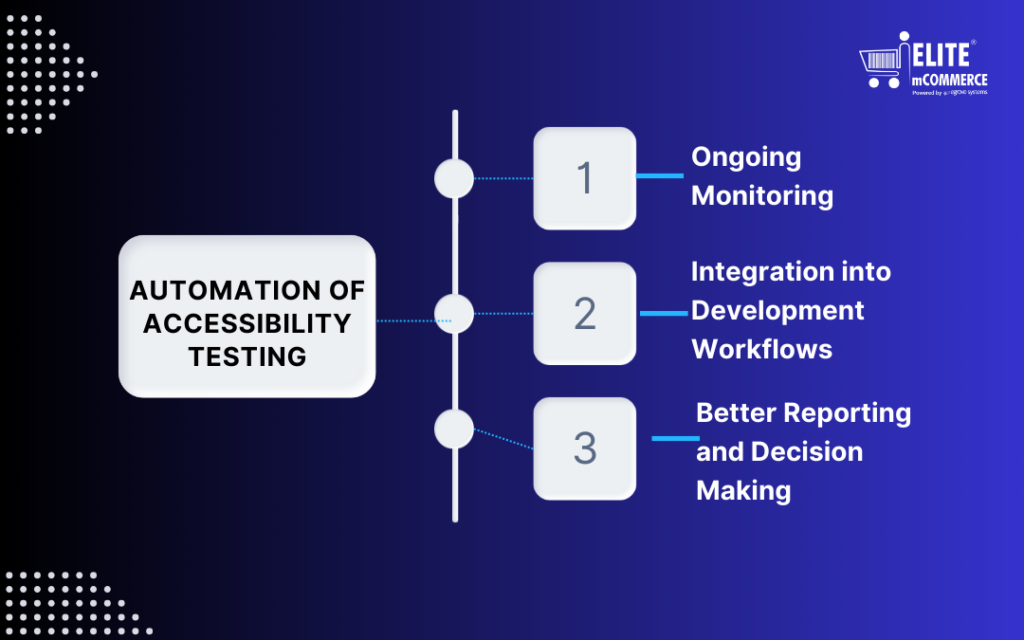
Automation complements AI for web accessibility, ensuring it does not become a one-off activity. Instead of performing audits from time to time, businesses can run digital accessibility solutions that marry automated testing into development pipelines. Automation supports:
- Ongoing Monitoring
Automated monitoring tools test websites and applications against WCAG standards regularly. Whenever any updates or changes are made, the system immediately flags issues it encounters. This means the process is keeping the website or application accessible across every version of the digital asset.
- Integration into Development Workflows
Developers can now perform accessibility checks as a part of their DevOps or CI/CD pipelines. Instead of waiting to address potential issues during testing or even after the product has launched, when it might be too late or too costly to fix, this has enabled developers to identify possible issues earlier in the development lifecycle.
- Better Reporting and Decision Making
The reporting aspect is also enhanced when accessibility checks are automated. Dynamic dashboards and analytics can showcase accessibility performance data. It presents to users the ability to spot recurring issues and where improvement happens in overall compliance. This allows for stakeholders or decision makers to move accessibility reporting from more of a technical task to being no longer a box to check, and providing a measurement business goal.
Personalization & Customization: Machine Learning for Inclusive Digital Experiences
Machine learning is taking accessibility to the next level with predictive and adaptive capabilities. It enhances end users’ digital accessibility solutions and improves their experience. The following capabilities make this feasible:
- Predictive Accessibility
Machine learning models can ingest and analyze large data sets of previous accessibility audits to predict areas or sections of a website that will likely have issues. This gives developers an opportunity to work more effectively, as you can provide insight to areas to prioritize that are based on risk.
- Adaptive Learning for a Better User Experience
ML algorithms not only process user interactions and capture information about them, but they also adapt digital environments to all of the preferences expressed in real-time user interactions. For example, systems that have voice controls to navigate may learn based on the patterns of a user’s speech. Similarly, a digital environment may learn to change the visual layout of its content to simplify navigation for users who are only using a keyboard to navigate through.
- Voice and Visual Recognition
Voice-enabled systems and images ranked according to the input given to ML models are essential to enabling accessibility. To facilitate hands-free communication, speech recognition is crucial. In the same way, the visual recognition allows image descriptions, which increases digital accessibility solutions for individuals with disabilities.
Closing Thoughts
Accessibility is quickly becoming a key element in designing digital experiences. The combination of artificial intelligence, automation, and machine learning tools is changing how organizations become inclusive. With advancements in technology, accessibility is expected to evolve into an experience that concerns more with empathy and not just about compliance.
Digital accessibility applications can be used for advanced accessibility, then AI can further be used for digital web accessibility, so no matter someone’s capability, they can e-future enable their digital presence and engage and access with ease in digital space. Empower your accessibility journey with intelligent automation, choose Elite Site Optimizer to make your digital presence truly inclusive.
Related Posts